
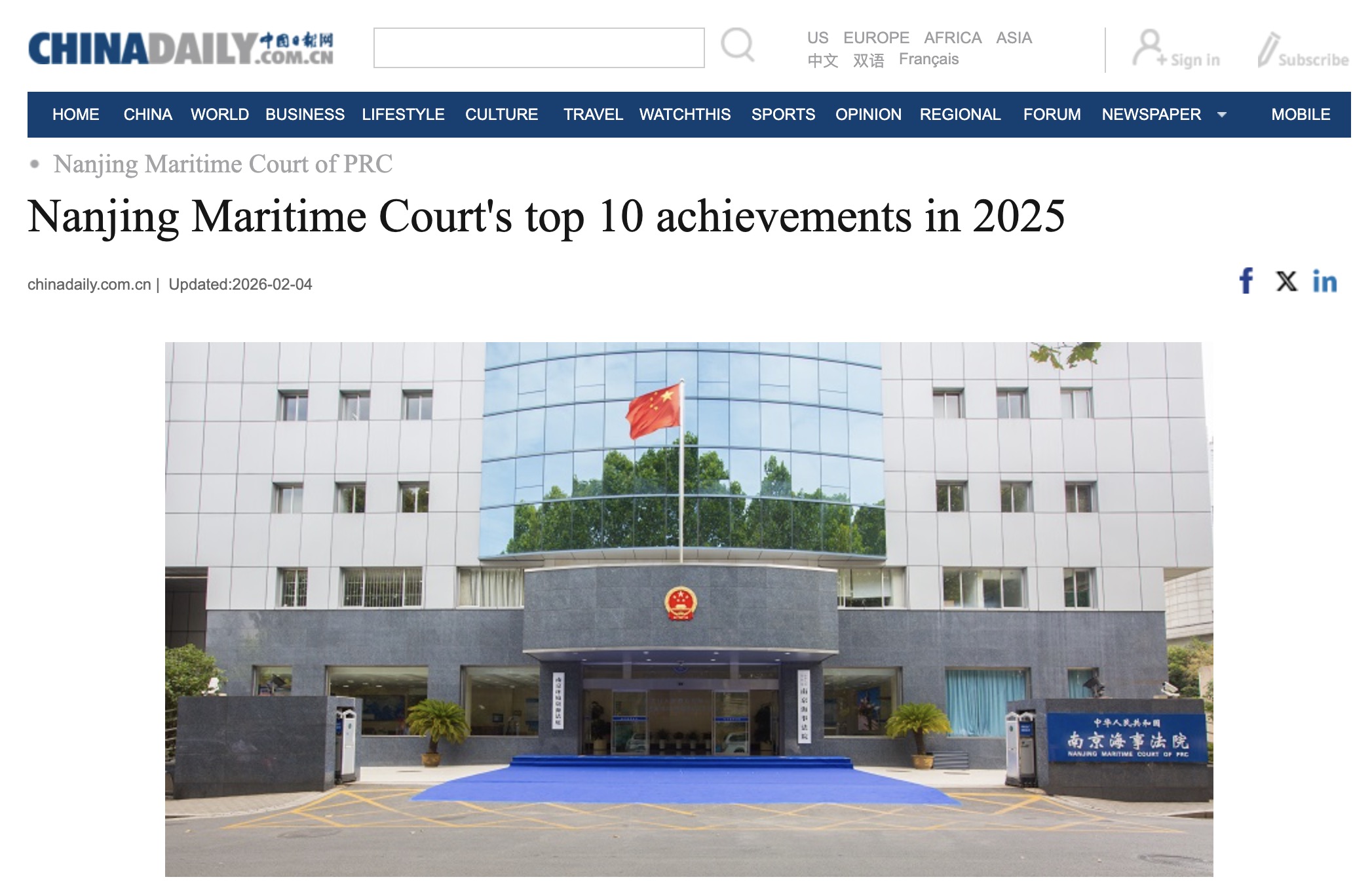
Nanjing Maritime Court of PRC, based in Nanjing, East China's Jiangsu province, accepted 4,899 maritime and maritime commercial cases in 2025, with 4,249 of them concluded. Both the number of cases filed and concluded ranked top among maritime courts in the country, giving an additional boost to the court’s international credibility.
1. Firmly safeguarding national sovereignty and maritime rights and interests
The court comprehensively exercised its jurisdiction over foreign-related maritime disputes with connections to China and where China has jurisdiction. Throughout the year, 482 foreign-related cases involving 74 countries and regions were accepted, covering major global economies. The court concluded the nation's first lawsuit concerning infringement due to foreign sanctions, facilitating reconciliations between the parties involved within just 39 days.
2. Serving the development of the marine economy and new quality productive forces with a targeted approach
The court rolled out measures to serve and safeguard the construction of a strong maritime province in a more effective manner, continuously improving the mechanism of judicial protection for marine development and utilization.
In one contractual dispute regarding the construction of Anchor Handling Tug Supply (AHTS) vessels, which are specialized ships that combine towing, anchor handling, and supply functions for offshore operations, the court adopted measures such as "seizure without halting construction" and the introduction of partners for advance payments, to help a struggling private shipbuilding company overcome difficulties and attract international orders.
In another case, the court effectively and efficiently handled disputes related to the construction of the largest wind power cluster in Asia, ultimately safeguarding its development. To support new marine technologies and industries, the court proactively gave risk advice before the trial production of the Suhai No 1 aquaculture vessel, assisting in the successful launch of the world's first salmon farming vessel.
3. Serving and safeguarding high-standard opening-up
Committed to fostering a world-class, market-oriented business environment governed by a sound legal framework, the court actively participated in the construction of pilot zones for foreign-related legal services and safeguarded the interests of enterprises going global.
It continuously improved the diversified resolution mechanism for international maritime disputes, supported arbitration agreements in line with the principle of favoring their validity, and encouraged innovations in temporary arbitration systems and rules to create an arbitration-friendly judicial environment.
To improve litigating parties' experience, the court tried to align with international rules, fulfill international treaty obligations, and efficiently determine applicable foreign laws at a low cost.
It also optimized its website in both Chinese and English, improved bilingual litigation guides, simplified procedures for foreign document evidence, and established a quick ship-seizure-and-release channel to address inconveniences caused by language and cultural differences for foreign parties.
4. Striving to become a preferred venue for international maritime dispute resolution
The court issued Guidelines on Striving to Become a Preferred Venue for International Maritime Dispute Resolution to continuously enhance the efficiency of foreign-related maritime justice.
Throughout the year, 515 foreign-related and Hong Kong, Macao and Taiwan-related cases were accepted, a 37.7 percent increase year-on-year, including 260 cases related to countries and regions involved in the Belt and Road Initiative, up 34 percent year-on-year.
The court also advanced the construction of a maritime judicial research center. It actively aligned with international rules, and recorded the Voice of Maritime Court in English, with two cases published by academic publishers like Informa Group from the United Kingdom.
It also released a bilingual white paper in Chinese and English and a report of typical cases on foreign-related and Hong Kong, Macao and Taiwan-related maritime trials, presenting China's philosophy on maritime rule of law and successful practices, and effectively telling the story of China's maritime justice.
5. Fully supporting the construction of a distinctive "water transport Jiangsu"
The court adjudicated 395 disputes related to inland waterway shipping in the Yangtze River and the Grand Canal in accordance with the law. It also efficiently resolved 12 disputes concerning the Yangtze River shoreline rectification, providing strong judicial support for the construction of the province's trunk waterway network featuring a "two vertical and five horizontal" layout.
6. Forging a judicial shield for marine ecological environment
Focusing on the theme "legal protection for marine resource development and environmental protection", the court collaborated with 10 governmental authorities administering ecology and environment, natural resources, agriculture and rural affairs and other sectors to discuss specific and pertinent measures.
The court furthermore innovated the implementation mechanism for public interest litigation in marine ecology and environmental protection, and promoted the improvement of direct handling mechanisms for marine environment public interest litigation by the procuratorial authorities in the cities of Nantong, Lianyungang and Yancheng.
7. Continuously enhancing the "one-stop" water dispute resolution brand
In collaboration with Jiangsu Maritime Safety Administration, the court upgraded the existing water traffic accident dispute resolution mechanism to a one-stop mechanism covering all water-related disputes. This was hailed as an innovative example of adhering to and developing the "Fengqiao Experience", which has been recognized by foreign media as an "effective social governance plan deeply rooted in Chinese culture", in the new era to be promoted nationwide, when the Supreme People's Court and the Ministry of Transport held a special press conference on Jan 7.
8. Strengthening the protection of maritime-related rights and interests concerning people's livelihoods
The court accurately applied special legal provisions for seafarers who board and work on vessels, and are later repatriated, supporting seafarers in recovering any unpaid wages. It adjudicated 342 labor contract disputes for seafarers in accordance with the law, recovering 46.7 million yuan ($6.7 million) in unpaid wages for them.
9. Intensifying the "Boutique Strategy" in maritime adjudication
The court effectively managed adjudications in line with the law of maritime justice. It formulated and rolled out guidelines for reviewing case documents and handling major sensitive cases. The adjudication committee monitored long-pending cases on a regular basis, served as a "watchdog" for the adjudication of new types of sophisticated cases, and unified legal application and judgment standards.
The quality and efficiency of maritime justice improved significantly, with a substantial increase in both the number of concluded cases and the conclusion rate. This included a 2.66 percentage point decrease in the appeal rate year-on-year, a 62.5 percent reduction in long-pending cases year-on-year, and an average case conclusion time shortened by 5.86 days year-on-year.
10. Strengthening efforts in cultivating high-caliber professional talent
The court innovatively set up a differentiated assessment and evaluation mechanism. It established a "2+4" assessment system, distinguishing among judges, assistant judges, judicial administrative staff, clerks, and other hired personnel, with a focus on key indicators regarding judicial quality and efficiency, innovation capability, contribution, and judicial resources.
It also strengthened the training of young judicial officers. Among the specific measures it rolled out, a five-year plan for strengthening its cadre team and a guideline for enhancing the training of assistant judges were formulated.
The court also established a system for assistant judges to attend adjudication committee meetings and theoretical study sessions of the leading Party members group, and selected seven assistant judges to gain experience in demanding positions such as at the petition, enforcement and circuit courts.